

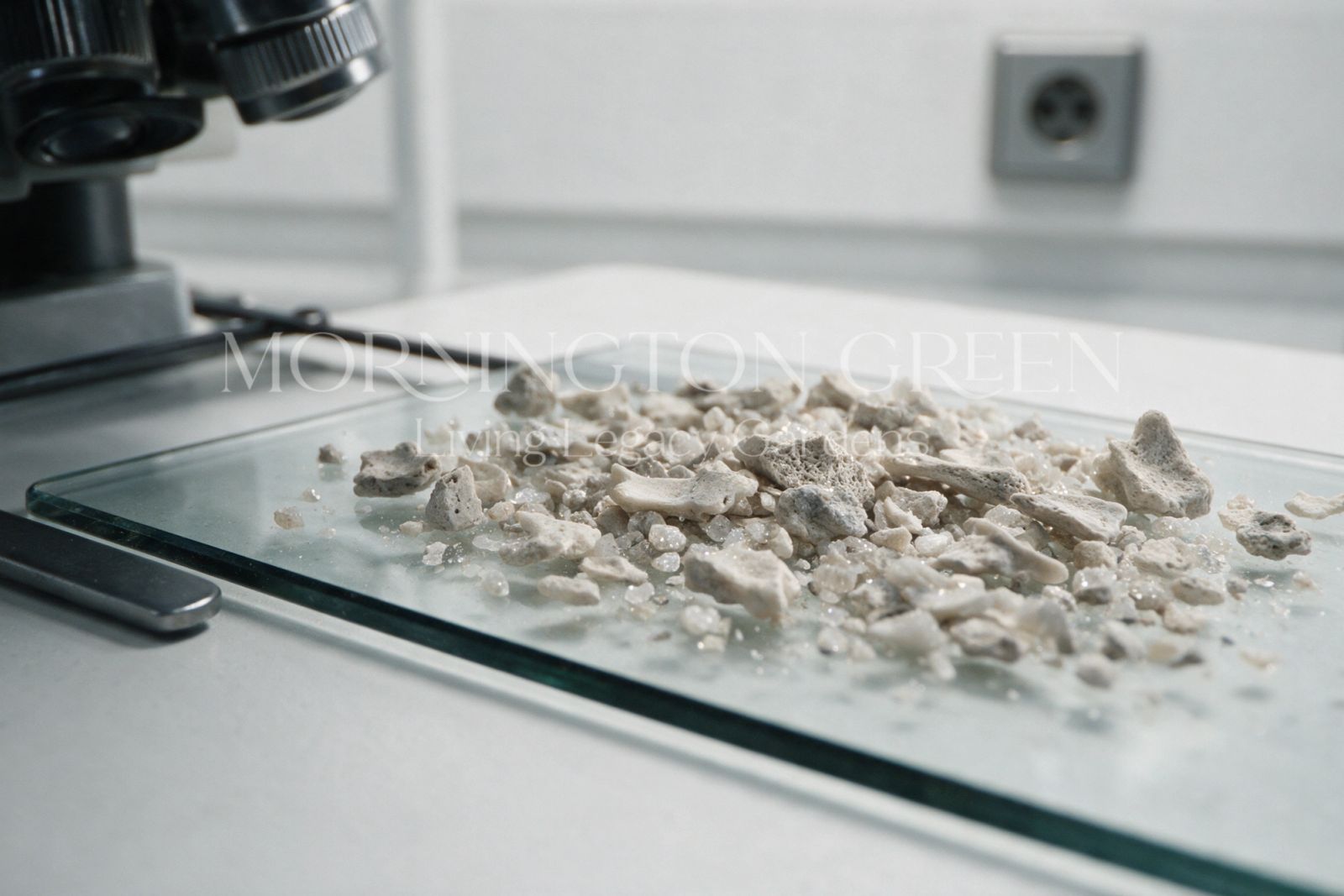
An adult's cremated remains weigh 3 to 4kg, and none of it is ash in the fireplace sense. Cremation temperatures run between 760 and 980 degrees Celsius. At that heat, nearly all organic material in the body burns away or releases as gas, mostly carbon dioxide and water vapour. Bone makes up most of what remains. Under a microscope, cremated remains show bone's mineral structure, the part combustion leaves behind.
What Remains After Cremation

Calcium phosphate holds bone together, a mineral compound stable enough to survive cremation intact. It makes up most of what's left once the organic material is gone.
Technicians then mechanically process it into the fine, sand-like texture people call ashes. Cremated remains is the correct term, not ash, a distinction we cover in more depth in what actually happens to ashes after cremation.
Composition varies from person to person. There's no single fixed formula: bone density, age, diet, and health all affect the mineral content someone carries. Elemental analysis of cremated remains generally describes:
- Calcium phosphate as the dominant component, typically the majority of total mass
- Smaller amounts of sulfate, potassium, sodium, and chloride
- Trace elements including silica, aluminium oxide, and magnesium
The color, pale grey to off-white, comes from the same source: it's bone's natural color once combustion strips everything else away.
Are Cremated Ashes Safe for Soil and Plants?

Cremated remains test at a pH of 11 to 12.5, measured directly from ash samples in laboratory trials. For comparison, household bleach also falls around pH 11 to 13, and most garden soil sits between 6 and 7. High sodium content adds a separate concern on top of the alkalinity. Together, they create soil conditions plants struggle with.
Separately, a 2022 peer-reviewed study measured a real scattering garden and found that roughly half its vegetation had degraded to unhealthy or bare soil over time, with worse damage where families had scattered ashes more densely. The study didn't isolate pH or sodium as the specific cause, but the correlation with scattering intensity matches the known chemistry. We go into more of the environmental picture in are human ashes bad for the environment.
Plants can't straightforwardly access that calcium phosphate either. Peer-reviewed soil science comparing calcium phosphate compounds across soils of varying pH found low availability for hydroxyapatite, the form closest to what's in bone, across soils overall. Related tricalcium phosphate compounds showed the same pattern on alkaline soils, the same range cremated remains fall into. Either way, the mineral content is present, but the surrounding chemistry limits how much a plant can draw on.
Some memorial providers, including Living Legacy Forest, now treat cremated remains before combining them with soil to address this, an approach we walk through in choosing and sharing a memorial tree.
Mornington Green is currently offering free ash infusion on every Living Legacy Tree this September.